
Seattle Ashram circa 1977
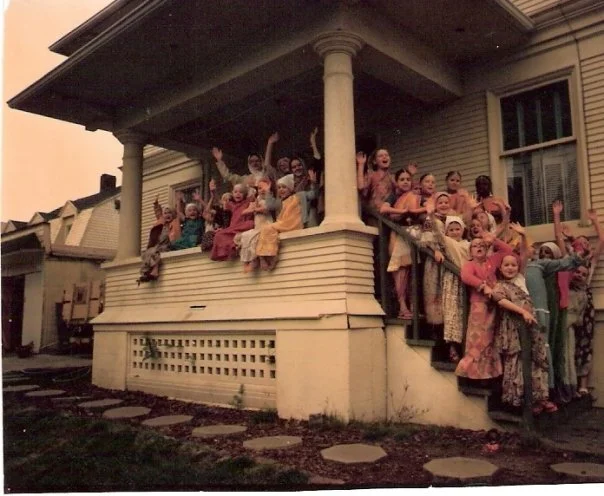
Seattle Girls Ashram
I am six years old. I live in a Hare Krishna ashram in Seattle, in a creaky house with wood floors and big windows. There’s one shower, a toilet and a big kitchen. My neatly rolled up green hunting sleeping bag with ducks on it and my suitcase full of skirts, saris and headscarves (socks and underwear too) is stored in the corner of the asham room. Some of my friends from Dallas are here. I’m happy to see them. They show me around and we play outside in the yard, while my mom talks with the ashram teacher. I remember her from Dallas too. I don’t like her. She’s mean. My mom is going home in a few days and I’m staying, but I’m not happy about it, so I watch her closely to make sure she doesn’t disappear.
As I settled into my new ashram, I easily make new friends. Some of the girls are funny. We laugh a lot. On the first night, the teacher shows me my space on the floor and I lay out my sleeping bag next to the other girls. Around 6 pm, after dinner, we go to our assigned sleeping bags, lay down inside, and fall asleep to the soothing voice of a women telling krishna stories and singing songs. My mom is in the women’s ashram close by. Knowing that helps me fall quickly asleep.
So far, I like it here. The trees are pretty and smell like candy. On our walks, I see a huge mountain that looks like heaven, and all around the hills go up and down making me dizzy. In Miam where I used to live, the streets are flat. There’s a park nearby with lots of trees and winding stairs. It feels like fairies might live here. My mata brings my baby brother with us this time. He’s so cute! Everyone loves him. I tell everyone about him and because I’m big enough now, Mata let’s me push his stroller.
After a week, Mata tells me she is going back to Miami. I don’t want her to leave me again, and I cry. She hugs me tight and reminds me that we’ll talk every Sunday and that she’ll write me letters and send me packages. I’m don’t want her to leave and I don’t let go of her, but all the girls in my ashram are going to the playground, and I want to play too. Mata walks with me, holding my hand. I think if I hold her hand long and tight enough, she won’t let me go either. Shortly after we get to the park, I see a white van drive up and a door opens. She looks at the van and then at me. “It’s time for me to go”, she says. tells me with a sad smile. My chest cracks and the heaving starts.
She gets down on her knees with her face close to mine. My head is spinning and my eyes are hot. She hugs me tight and I hug her tighter. My stomach turns to knots and I want to throw up. I scream instead, as loud as I can. “Mata” “Mata” Mata”. Can’t she hear me? She and my baby brother get in the van and I watch them drive away in disbelief. My teacher reaches out to touch my shoulder, and I push her away. My screams turn to sobs. I can’t breathe.
Satya, an older girl who is 8, takes my hand and walks me to the playground. We sit down under the monkey bars and she holds me for a really long time. Satya is soft and sweet and feels like a mommy and I lean into her until I catch my breath.
She tries to reassure me. “You’ll get to talk to your Mata on Sunday. It’s okay, Radhe. It’s just a few more days.” It’s hard to hear her through my sobs. My heart feels shattered again.
The weeks go by and I settle into my new life. I lose two front teeth, learn how to braid my hair and the other girls in the ashram. We learn how to do fish braids too. Sundays are body care days and after we’re all washed, we sit for our braid train, proudly brag about our new found talents.
Ashrams are divided up by ages. In my ashram, we are all about 6 years old, and most of us have been separated from our families. We’re from all over the country and not a parent in sight. On any given night, the soft sounds of sniffles covered up by our sleeping bags is heard throughout the evening, until eventually we are all asleep. Several of us are occasionally still wetting our beds at night.
One day, after several of us younger girls wet our beds throughout the week, our ashram teacher is fed-up and furious. We are rounded up, given buckets of soapy water and wash cloths. We are told to put our pee-soaked underwear on our heads and clean the floors. Our raw knees slide from side-to-side as we swish the wet rags across the wood floors, cleaning up our mess and filth.
This teaches us a lesson. The seeds of humiliation begin settling into our bones.
Sometimes, during the week, we’re allowed to play in the park. The big girls and little girls get to go together. I love going to the park because I can get lost in the trees where no one can yell at me, and no one can see me but the flowers and bugs and the bees. It reminds me of Miami.
While I love being at the park, the walks to the park aren’t fun at all. Our headmaster yells a lot, and makes us lay on the street in obeisances to her. The street is dirty and smelly and wet. She seems angry and hear little eyes and pointy nose makes her look like a witch. I giggle quietly. She pouts and shouts and threatens us with her saffron stick, that if we don’t obey her and lay our bodies down on the street and stretch our arms out in surrender to her, we are offensive little brats and will certainly suffer bad karma. I’m scared, so I do it. I’m also embarrassed because I’m wearing a long skirt, a headscarf and tilak on my forehead. Tilak is holy mud if you didn’t already know that. I don’t look like the other kids at the park. None of us do, but at least we’re all together. The karmi kids get to wear shorts and pants and don’t have mud on their faces. I want to hide. I miss my mom. I want to go home, but I can’t. So I lay on the street with my friends, our chins on the grimey ground until we’re told to get up and keep walking.
In the ashram, Sundays are special: they are for phone calls with mata and pita, body-care days, and the Sunday Feast. The calls with my parents are the one thing I look forward to all week. Us kids, talk about our weeks in Sundays so we don’t feel so desperate. I feel sad for the kids with no parents because they have no one to call. But I have mine, and from the time it turns to Monday, I count down to the next Sunday.
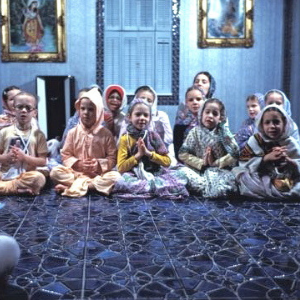
The Sunday Feast is our weekly holy celebration — we get to do plays about my favorite Krishna stories, wear fancy saris, play outside and the best part is, we get to eat halava, gulab jamuns, sweet rice and puris. It’s usually always fun.
One Sunday morning before the feast, and a few days after the pee accident, I walk up to my ashram teachers room and call my mom and dad collect. “This is Radhe, your daughter” I say. My parents accept the call and at the first sound of their voices, I feel relief. In an instant, I burst into big hot tears. The sound of their voices feels safe. I need to tell them what happened and that I really want to come home. From the right side, I feel my my teachers hand on my hand and I squeeze the phone harder, and just as quickly she takes the phone out of my tiny hand and says, “Radhe is fine. She’s just a little upset, but she’s okay. We’re taking good care of her.” She hangs up the phone.
LIAR! LIAR! LIAR! I can’t believe she took the phone out of my hands and hung up. LIAR. The tears fall hard. This is my only chance to tell them what happened and I miss it.
***************************************************************
From then on, every call and letter I write is monitored, my letters are reviewed and rewritten, omitting any mention of missing my parents or wanting to come home. And I am never again allowed to say or write “I love you” or “Love, Radhe” at the end of my letters. It is replaced with “Your servant” or “Your daughter”.
As long as our communication with the outside world is monitored or forbidden in some cases, our parents never know what was really going on. We are all prisoners at the mercy of maniacs disguised as gurus and gods.
The hollow ache and pain of feeling powerless is overwhelming.
It would be another 24 Sundays before I have a private conversation with my parents.
By then, everything would be very different.
